|
What are FAA Knowledge Tests?
If
you want to be a pilot (or get an additional license/certificate/rating
after you already have a basic private pilot's certificate) then you'll need to take a and pass an written (knowledge) test sometime before you take a
flight ("practical") test with an examiner pilot.
This is similar to how you need to take a driving
theory test before you go for your driving license road test.
Some flight schools require you to pass the knowledge test earlier on in your course of training. Particularly diligent students (maybe even you!) take and pass their knowledge
tests before even stepping into the aircraft for the first time in order to maximize their knowledeg and hence minimize their training costs going forward.
The FAA private pilot knowledge test draws from a question bank of approximately 1000-1500 questions and covers a wide variety of topics from aerodynamics to regulations to flight physiology and psychology to airspace and charts and weather and everything in betweeen.
There's a lot of stuff to learn, but it's certianly manageable if you devote the necessary time and attention.
Our
FAA written test preparation software and apps
are all you need to study for and pass their your next FAA knowledge test. They contain:
- actual and realistic FAA questions
- all the required charts and figures
- detailed and informative explanations written by experienced flight instructors, examiners, and professional pilots.
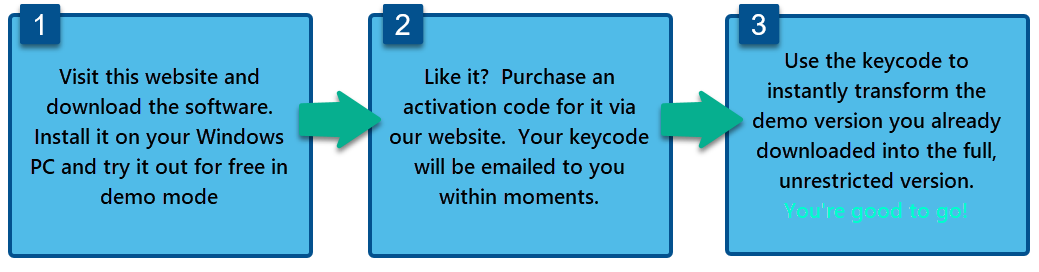
The way that it works is that you
- download our app for the platform of your choice (PC, Mac, iOS, and/or Android)
- start the app
- click on "check for updates" from the main menu to make sure you have the latest and greatest content (and you can check this from time to time later on - updates are free! Our editors upate the material regularly as the FAA upadates their question banks and regulations change.)
- click on "Study.." from the main menu
- select your exact test (for example, Private Pilot Airplane so that you won't be presented with unnecessary helicopter questions, or vice versa)
- select the chapters that you wish to study during this session
- select your study mode. Our apps contains a number of study modes including:
- Flashcard mode - where you just read the questions, answers, and explanations
- Continuous practice mode - where you are presented with a continuous series of questions for intensive, time-efficient practice. With your choices of seeing the correct answers immediately or at the end of the session
- Simulated test mode - where the content, time limits, and number of questions is just like you'll see on the actual test.
- study away! use the highly polished user interface of our apps to learn the material well.
It is important that when you study you don't just memorize the questions, but that you use our detailed, illustrated explanations to really learn the material. This will best prepare you for any new or re-stated questions that the FAA may put on your actual test and will also
mean that you will develop a better working base of aviation knowledge for your flight training and, later, for your practical test / check flight.
Once you can consistently score well (we recommend mid-90s) on multiple (we suggest at least 5 and preferably 10 or more) simulated practice tests, you'll be ready to take the real thing. You'll need an
endorsement from a local instructor or school to take the actual test, but this will be very easy to get if you show them a record of theyour diligent study using our apps. Flight instructors and schools like nothing more than well prepared students coming their way and
really, getting an endorsement if you're basically ready to take the actual test will be quite simple.
The actual tests are administered on computer at a testing center. As of this writing, test results are valid for 24 calendar months from the time you take them.
Many
people who use our products are student pilots who have already started
their training. Others are more ambitious and use our test prep apps before
they even start training in order to ultimately be better prepared
and save money (a small number probably also use our apps to study a few days
before their certificate-granting flight test in a semi-panic because
they've put off actually doing the knowledge test for too long--we can't
agree that this is the best way of doing this, but, well, the software
can certainly be used for that as well!)
If
you're a new potential pilot, you may have heard something about organized
"ground schools" where you sit and an instructor teaches
you material, classroom-style. This might be at an airport or at a
local community college, for example. Let's get one myth (often not
denied by the outfits offering such courses) out of the way quickly:
certain, very limited exceptions notwithstanding, there is no FAA
requirement to attend such a course. In fact, the vast bulk of pilots
never take such courses! The FAA requires passing the written test
and then later a flight test.
That
said, there's nothing wrong with attending such a ground school class.
You can interact with other students and learn together, if that's
your thing. Plus, you can ask questions. In fact, we (your authors)
regularly teach such classes. We just want to make it clear that there
is no requirement for this.
If
you want to impress your instructor and save money, get your written
test out of the way as early as possible. While clearly we have some
vested interest in saying this as, after all, we sell preparation
software for the tests, by all means feel free to verify this by talking
to others in the know. Many people prepare for their written tests
while saving money to actually doing the flight training--this is
an excellent strategy on several levels.
To
actually take the test, this is what you need to do. First, of course,
you need to learn the material. A few nights with our software should
get you into good shape. The actual tests are multiple-choice (3 choices
per question) and you need to get a 70% or higher to pass. We recommend
that users be able to score at least 90% consistently using the practice
test modes provided by our software before they go take the real thing.
Heck, you're going to need to know the stuff anyway. Once you know
the test, to actually take it (and this relates to most FAA tests,
including the private pilot airplane and helicopter written tests
that most people start out with) you need to have an instructor's
"endorsement" - a piece of paper with some magic words and
a signature that you take to a testing center as a "ticket"
to show that you are indeed ready to take the test.
Where
will you get this endorsement from? The best way is to
go to your local flight school and have a chat with an instructor.
Perhaps bring some printed score reports with you from the software or screenshots from our app
to evidence that you know the stuff. You're not expected to be a
complete expert at the material at this stage, but if you can show
that you've studied, many instructors will be happy to give you
an endorsement there on the spot (heck, as instructors, We're thrilled
when new students come to us like this - well-motivated and prepared
students are a pleasure to teach!) He/she may well give you a signoff
there on the spot.
Now, we
want to be clear about something - just because you can pass the written
test doesn't make you an expert at the stuff. That's ok! Don't worry
about it -- you're not expected to be an expert. What the written test
is useful in that it ensures that you have first-pass familiarity
with the subject. Then, when you actually go into the flight training
bits, it will really start to come together. Some of the stuff that
seemed pretty esoteric when you were studying for the written test starts
coming together into coherent wholes. Learning to fly is a process!
A score
report from an FAA written test has a validity of 24 months.
Return to
the FAA
Written Test Prep page. (you probably want to select Private/Recreational
Pilot from the next screen)
Ok,
you've pretty much read what there is to know if you've gone this
far. However, if you want some more info in slightly more detail,
read on! But, by all means, do download the software and try it out--remember,
you can download it for free, and if you decide to buy it our software
costs less than competitors' offerings and is better stuff, anyway!
Good luck in all your flying goals!
Who needs to take FAA written tests?
Certain,
very limited exceptions notwithstanding, every person who wishes to
get an FAA private or recreational pilot certificate must take and
pass a multiple choice knowledge (formerly called "written")
test. While the specifics varies slightly based on different situations,
for the vast majority of people, the test is 60 multiple choice questions
administered on a computer at a local flight school or testing center.
There is, again generally, a 2.5 hour time limit and the minimum passing
grade is 70%.
After
you take the test, you get a printed score report from the test center.
If you passed, this becomes a ticket of sorts. When it comes time
for you to take your "checkride," that is, the combination
flight-and-oral test with an examiner pilot, you must bring this report
to the checkride. The score report has a validity of 24 months after
the test was taken.
Is it a useful test?
There
are two schools of thought on knowledge tests.
One
school of thought says that the knowledge tests are a pedantic exercise
in FAA bureaucracy. Get your 70% or better, the theory goes, and forget
about it.
The
other school of thought says that the tests serve to introduce students
to the requisite theory, and thus are a building-block to further
effective learning and that the tests are a indeed useful pre-qualification
for the checkride. When you show your score report to your checkride
examiner, for example, he might be more satisfied with your state
of understanding of the theory if you scored a 98% rather than a 72%,
and anecdotally the "oral" portion of your checkride might
end up being that much easier (examiners have a fair deal of judgmental
leeway on what they ask on the oral portion).
Independent
of our work on the GroundSchool products, we happen to think that the
knowledge test is quite useful--We personally find that students who
start their written / knowledge test studying early generally require
less time to master concepts in the air because, simply, they're not
effectively doing bookwork in the air. With training costing roughly
$150+ an hour all told, this can be quite a savings. Additionally, students
feel more confident and satisfied when they have a better understanding
of what's going on before they do it. It makes everybody's life easier.
In fact,
many of us require our students to be able to pass their knowledge test before
we let them solo. This has proven to be good motivation, to say the least,
and the results have been win-win. More typically, many students take
the knowledge test somewhere between their first solo and the checkride.
You occasionally hear stories of students taking the knowledge test
the morning of their checkride--we shudder.
Yes, it's
possible to also be versed in the theory by reading books and articles
beforehand, but I find that students invariably do a lopsided treatment
of the material this way. Very few people, for example, voluntarily
read up on and really learn the necessary minutiae of weather charts
and graphs without prodding. The knowledge tests, therefore, serve as
a sort of leveller or sieve to make sure that you're studying in all
the right areas, rather than just reading the interesting but non-critical
sidebars on, say, how the space shuttle's tires work or how da Vinci
invented the helicopter.
Opinions
on this legitimately vary, however. While the knowledge tests are quite
comprehensive, they're occasionally accused of containing content of
questionable usefulness (reference the "minutiae of weather charts"
statement above). I think that this criticism is mostly (but not entirely)
"hangar talk." I deal with these questions every day and for
the most part find them to be well thought out. Nevertheless, even if
you disagree, the fact of the matter is that you're going to need to
take the test one way or another. You might as well do it now.
A strategy for minimizing training time and cost ...
At the
risk of being accused of "hard selling" our software, let
me give you some advice we wish somebody would have given us when we first
started flying--be able to pass the knowledge test as early as possible
(and this applies for every certificate or rating you may get down the
future) and you will save time and money during your training. For potential
private pilots, We suggest going on a single introductory flight to whet
the appetite and then doing the nearly impossible task of not going
back to the airport for a couple of weeks while you study for the written
test. For most people, the lure of blue skies is too much--I've only
ever encountered a small handful of people who have actually been able
to stay away until they really got their heads around the theory (and,
after all, actually flying provides context in which to learn some of
the material) and so we want to make it clear that what we're suggesting
is not a rule--but just a guideline that gives you an idea as to how
we suggest thinking about the knowledge test.
Note also
that we said "be able to pass" the knowledge test. For most
people, you need to have an instructor's signoff to be admitted to the
knowledge test. When you're first starting off, you may not know of
an instructor who will give you the signoff. Don't worry--prove to any
instructor that you can pass the knowledge tests (perhaps by bringing
him/her some score reports from our software?) and you'll get that signoff
without too much difficulty.
How to study for the tests ...
Now--about
the actual study. Fortunately, the question pool for the tests is limited
and known. Using our software, you study the actual questions, and,
in fact, if you so choose, you could partially memorize the answers.
we trust that we'm not provoking a scandal when we say this--this is true of
whatever method of test preparation you choose. The software is designed
to be fast and efficient--learn the questions, and, if you want clarification,
read the explanations provided by the experienced professional pilot
/ instructor authors.
What about classroom-based "ground schools"?
One thing
needs to be said about "ground schools", that is meetings
at the local flying club or community college where the instructor lectures
for a few hours for a few weeks and you part with some amount of money
($100-$250, typically) for the privilege. It stands to note that such
courses are purely optional--there is no FAA requirement for taking
such courses and the vast majority of pilots get their certificates
without ever attending them. When such courses are well structured,
these can be a good supplement to our software in that you can discuss
things (be they in the knowledge test or not) with the instructor and
fellow students to gain insights. From a well run class that runs, say,
for 8 weeks for 2 hours a week, you shouldn't actually be ready
to take the knowledge test because this would imply that you spent too
much time on cramming questions and not enough on discussions. Ironically,
from a poorly-run course, you might well be ready to take the test because
poorly-run classes are often little more than question memorization
sessions. Classes are good for the human element--leave the test prep
to your own time with our software.
We hope that
we have answered your concerns about the knowledge test. If you have
additional concerns, please don't hesitate to contact us by submitting
a ticket to our
helpdesk system.
Blue Skies,

The GroundSchool Team
|