|
NEW!!! Important Note about ATP 121 vs 135 Airplane Questions (and, to some degree, Helicopter and Dispatcher too.) In order to 'fatten up' the test banks a bit, the FAA has recently been 'migrating' questions between ATP test banks. This means that you might encounter questions on your FAA test that you might not otherwise expect to. For example, we have gotten a few times messages from users to the effect that "Why are you teaching me King Air questions on my ATP 121 test prep? / Why are you teaching me B737 questions in my ATP 135 test prep?" Why is the FAA doing this? In a word, to discourage memorization and because the 'migrated' content is similar enough that the FAA figures you should be able to know how do do it--after all, a weight and balance on EITHER of those aircraft is something that an ATP candidate for either ATP part should be able to do. This does not guarantee that you'll see such a migrated question, but it's definitely a possibility. Our test banks as maintained by our editors are designed to reflect this. If you feel that the chances of you seeing such migrated questions are slim, feel free to ignore them. However, please know that our editors have done this consciously with an eye to current test administration - so please don't end up like at least one person who, to their credit, after complaining to us about supposedly irrelevant questions later came back to thank us. Again, there's no guarantee that you will see such questions just like there's no guarantee that you'll see any one or group of questions on your test---but you very well might.
|
121 or 135? If you're an airplane pilot, the FAA offers you two basic choices of ATP written test to take. While there are a fair amount of questions in the test banks that are common to both...
- CFR 14 (FAR) Part 121 deals with scheduled air carriers - basically airlines. As such, the questions unique to this test largely involve things that an airline pilot might be concerned with, including not just part 121 regulations, but also the systems of larger, transport category aircraft.
- CFR 14 (FAR) Part 135 deals with commuter and on-demand air carriers. The questions unique to this test include Part 135 regulations and also systems questions pertinent to typical Part 135 aircraft.

Each of these is available in an "Initial" and "add-on rating" variant. The "add-on" is ONLY for those who already have an existing ATP certificate. In practice, this means that only if you already have an ATP Helicopter certificate would you take a 121 or 135 "add on" test. So, more likely than not, the "initial" one is what you ned.
But which of the two to choose? To make the best decision, read through ALL of the following.
From the Standpoint of getting an ATP certificate
From the standpoint of getting an ATP certificate: IT DOESN'T MATTER which you take . Your ATP certificate is not and will not be marked "121" or "135." For all practical purposes, after you get your ATP certificate NOBODY WILL ASK ABOUT, KNOW, OR CARE which of the two tests you took. This means, there is absolutely nothing wrong with you, for example, taking the 121 written test, getting your ATP certificate, and then moving on to take a 135 job (or vice versa).
From the standpoint of your ATP checkride
During the ATP checkride oral exam, the examiner may quiz you on topics that you had based on the written test you took. For example, if you took the 121 written test, he/she may ask you about 121 regulations. However, more likely than not, you will almost certainly NOT be asked either Part 121 or 135 REGULATION questions during the oral portion of your checkride UNLESS you happen to take your checkride in a 121 or 135 environment, which is very unusual. Expect the oral portion of
the checkride to be very much like your multi-engine checkride where you are asked practical regulation questions related to the aircraft you are flying ON THE DAY. Other than some very basic questions about part 121 or 135, you will almost certainly NOT be asked to go into them in depth during your checkride.
We want to emphasize that there's nothing wrong with taking the 135 test even if you're taking your checkride on your 121 airline's 737 which they loaned you nor is there a problem with having taken the 121 written test even if your checkride is flown with your charter company's Citation. The examiner will accept either one. Thus, the decision of which test to take is really one for you and not really something that has any bearing on your certification as far as the FAA goes.
From the standpoint of your next employer
Some employers want to see written test scores. If you're sure you have an interview lined up with that airline or bizjet outfit and you're sure they're going to want to see your scores, then we strongly suggest that you take the written test that corresponds best with their sphere of operations. That said, more often than not, this only applies to those who haven't yet met the hours minimum for an ATP certificate. For example, it is not unusual for a charter outfit that flies, for example, King Airs, to say something like "we will consider applicants without holding only commercial certificates and at least 700 hours total time. Such applicants should come equipped with a record of completion of the ATP written test." If this applies to you, in such a circumstance you should definitely take the 135 test.
From the standpoint of operational usefulness of the information
Here's the thing - if all else is equal, we encourage people to take the Part 121 test. Why? Because it's a more interesting and more relevant test to flying for tomorrow. That said, regs are regs. An interviewer for a 135 outfit may well grill you on the same sorts of 135-regulations that you would have prepared for had you taken the 135 written However, if you're going to interview with any employer, it's good to give such regulations at least as thorough a re-learn as you did for the written test. Frankly, things like 135 and 121 regulations will very quickly fall out of your head if you don't use them often. So, unless you're likely to have a 135 or 121 interview very very soon after your ATP written test, this might not be as big of an issue as you initially think it might be.
From the standpoint of your future career
If your ultimate career is likely to be in turbojet aircraft, then the 121 will teach you more that is applicable for the long-term.. When you're a 20,000 hour captain, or even a 4,000 hour co-pilot, nobody is likely to care which written you test you took. Heck, except for the cases described above, nobody is likely to ever really care which one you took. But preparing for the 121 test may teach you a few more advanced concepts than the 135 tests. For this reason, we recommend it.
So there you have it. In the end, it doesn't really matter that much. If you're sitting up nights because you can't decide which to take, you're doing something wrong. Flip a coin. Or take both, if you really really want to. Again, we suggest if you can't decide, that many pilots would learn more and be better served by taking the 121 test, even if an airline career is still somewhat far off, but we're sure some equally experienced instructors might counsel the opposite.
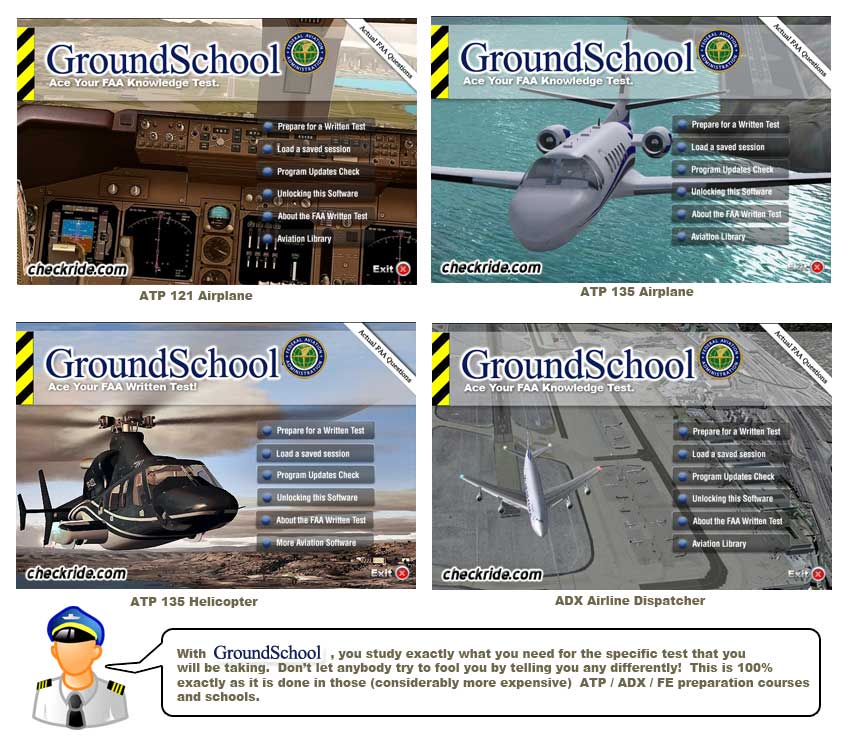
Regardless of what you choose, please remember that our GroundSchool ATP written test prep software can help you prepare for your test quickly and inexpensively.
Good luck on your test!
|