| Orientation
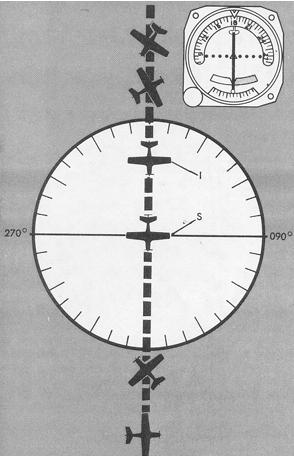
CDI Interpretation. With your receiver properly tuned and checked, rotate the OBS knob until the needle centers. Assume that the needle centers with the 180° course under the index (Fig. 8-2). Your aircraft can be on any heading and at any point over the north/south reference line shown, except over the station or close to it. Approaching inbound from point "I" to point "S", the CDI will deviate from side to side as the aircraft passes directly over the station where no signal is received. Likewise a centered CDI with any other course shown under the index locates your aircraft over either the selected radial or its reciprocal. Figure 8-2. CDI interpretation.
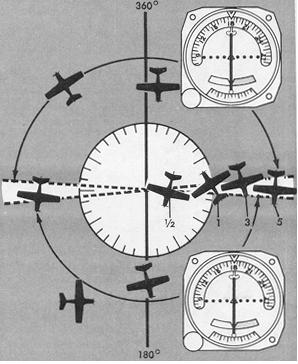
To/From Interpretation. With a course of 180° selected under the index, a "TO" indication shows, regardless of heading, whenever your aircraft is located within the approximate hemispherical area north of the 90/270 reference line. A "FROM" indication appears when the aircraft is located south of the approximate 90/270 reference line. Movement across the 90/270 area is indicated by an ambiguous TO/FROM signal. In this area, the resultant of the opposing reference and variable signals, which actuate the TO/FROM indicator, is insufficient to produce a positive "TO" or "FROM" indication. At a speed of 150 knots, the approximate times to cross this area at various distances from the station (Fig. 8-3) are as follows: Distance from
station Width (zone of confusion
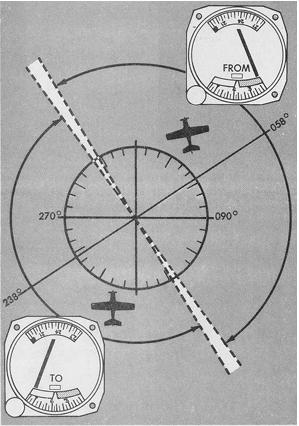
Likewise, with any given course under the index, a "TO" will show whenever your aircraft is located in the hemispherical area approximately 90 degrees on either side of the selected course. "FROM" will show in the other hemisphere. Note that the course index is at the bottom of the dial shown in Figure 8-4. CDI and To/From Interpretation. As Figure 8-4 shows the position of the CDI tells you that: You are on a specific radial (or its reciprocal); or you are to the right or left of it; with respect to the course selected. Figure 8-3. To/From interpretation.
Movement of the CDI, in conjunction with heading information, tells you: 1. Of impending station passage. Drift correction and time/distance checks will be discussed later in this chapter. The TO/FROM indicator locates you in one of two hemispherical areas, depending on the course selected, or in an area of weak signal strength. To determine the radial on which you are located: 1. Note the TO/FROM reading. To determine the inbound course to the station from your present position: 1. Read the inbound magnetic course directly from the reciprocal
window, following determination of the radial (if your indicator has no
reciprocal window, compute the inbound course arithmetically). Figure 8-4. VOR orientation.
3. To "home" to the station, turn to the heading indicated by the course index. Continue to recenter the needle and adjust the heading as necessary. Since homing does not involve drift correction, the aircraft follows a curved path to the station in a crosswind condition.
|