| VOR Receiving Equipment
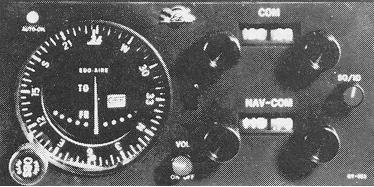
VOR signals can be received by a variety of airborne equipment. Tuning
equipment and visual indicators representative of current design are shown in
Figure 7-14. Irrespective of differences in dial design, method of tuning,
separation of receiver components, and multipurpose designs, all VOR receivers
have at least the essential components shown in the NAV/COMM receiver
illustrated in the figure.
Figure 7-14. VOR receiver.
The components of a VOR receiver can be described as follows:
1. Frequency selector. The frequency selector may be a knob or knobs
or "crank," manually rotated to select any of the frequencies between 108.0 -
117.95 MHz.
2. Course selector. By turning the OBS (Omni Bearing
Selector), the desired course is selected. This may appear in a window or under
an index.
3. Course deviation indicator (CDI). The deviation
indicator is composed of a dial, and a needle hinged to move laterally across
the dial. The needle centers when the aircraft is on the selected radial or its
reciprocal (Fig. 7-15). Full needle deflection from the center position to
either side of the dial indicates the aircraft is 10° or more off course.
assuming normal needle sensitivity.
Figure 7-15. Course deviation indicator.
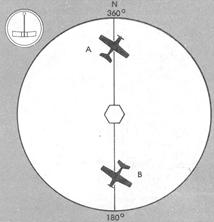
4. TO/FROM indicator, also called "sense indicator" and "ambiguity
indicator." The TO/FROM indicator shows whether the selected course will take
the aircraft TO or FROM the station. It does NOT indicate whether the aircraft
is heading to or from the station (Fig. 7-16).
5. Flags, or other
signal strength indicators. The device to indicate a usable or an unreliable
signal may be an "OFF" flag that retracts from view when signal strength is
sufficient for reliable instrument indications, or insufficient signal strength
may be indicated by a blank TO/FROM window.
VOR flight procedures will be discussed in Chapter VIII, "Using the
Navigation Instruments." VOR approach procedure charts are described in Chapter
X, "The Federal Airways System and Controlled Airspace."
 |
FAATest.com
- Aviation Library
Dauntless
Software hosts and maintains this library as a service to pilots
and aspiring pilots worldwide. Click
here for ways to show your appreciation for this service.
While much of this material comes from the FAA, parts of it are (c) Dauntless Software, all rights reserved. Webmasters: please
do not link directly to individual books in this library--rather,
please link to our main web page at www.dauntless-soft.com or
www.faatest.com. Thanks! |
|