| IX. RADIO COMMUNICATIONS FACILITIES AND EQUIPMENT
What communications equipment do you need for IFR operations? In uncontrolled airspace, none is required by regulation. What you need is up to your own judgment. For operations under IFR in controlled airspace, two regulations relate directly to the minimum communications equipment: a. (FAR 91.33 {§ 91.33 recodified to § 91.205}) Your aircraft
must be equipped with a two-way radio communications system appropriate to the
ground facilities being used. Information on making radio reports and on the functions and services of Air Traffic Control agencies are considered in Chapter XI. Ground Facilities For civil IFR operations in controlled airspace, the ground facilities
available for radio communications include the following components of Air
Traffic Control: Communications with these controlling units are normally conducted on
VHF frequencies between 118.000 and 136.000 MHz. Flight Service Stations, while
not exercising direct control over IFR aircraft, are ground facilities available
and used for radio communications. They play an important role in the total ATC
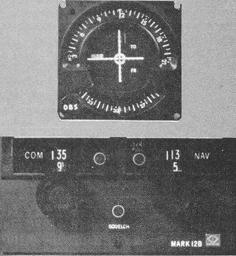
system (see pages 193 through 195 for details). The frequencies with which you should be familiar are listed below. The ILS and VOR frequencies listed may be used as receiving frequencies for communications as well as for navigation. Air Navigation Aids 108.10 - 111.95 MHz: ILS localizers Communications 118.00 - 121.40 MHz: Air Traffic Control Airborne Equipment Radio communications requirements have increased with the growth of aviation. Implementation of 25 kHz spacing in 1977 now provides 720 VHF channels (118.000 - 136.000) for air/ground communications. For training, however, you need only a transmitter and receiver suitable for communications with the ground facilities in your training area. Any lightweight equipment which provides the minimum standard frequencies included in the table above, may be sufficient for training but may be inadequate for the instrument rated pilot. Communications equipment of more recent design reflects the concern of manufacturers for the operational needs of the instrument pilot. Under the best conditions, a pilot flying on instruments must think, decide, and move quickly. Equipment design that contributes to indecision, uncertainty or fatigue creates unnecessary problems when the pilot is flying by reference to instruments. "One and One-half" Systems Figure 9-1 illustrates a dual-purpose radio typical of the "one and one-half" systems. These systems incorporate communications and navigation radios in a single compact unit. This is a welcome change from the older installations that required an extensive cockpit search to locate switches, selectors, and associated indicators and too much time to tune and operate. The "one and one-half" radio enables you to communicate with the necessary ground facilities on the transceiver (combined transmitter/receiver) while simultaneously tuned on the separate "one-half" of the set to a VOR station. This radio has controls that are easily identifiable and crystal-tuned frequencies that can be selected with only a glance or two for tuning. Figure 9-1. "One and one-half" system.
Operation of the communications sections of these radios is simple. The volume switch on the left is the ON/OFF switch for both COMM and NAV sections. The squelch knob is rotated to reduce background noise. While the set is warming up, set the knob fully clockwise; then turn the control counterclockwise to increase the squelch until the background noise is cut out. Further increase of the squelch setting will decrease receiver sensitivity. If you are tuning in a weak signal, decrease the squelch. Otherwise, once the control is established at a comfortable level, no further adjustment is necessary except to make an occasional check of receiver sensitivity. Transmit/receive frequencies are selected by rotation of the inner and outer knobs on the COMM side of the set. The "one and one-half" system described has the following communication/navigation frequency coverage:
Communications
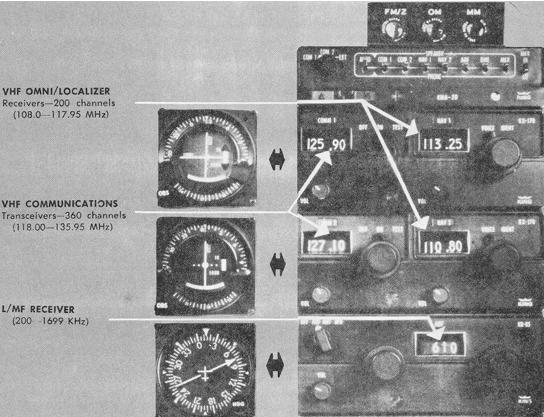
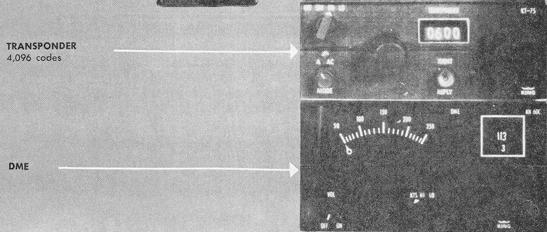
Navigation Expanded NAV/COMM Systems The advantages of the "one and one-half" system can be expanded with installation of additional radios and centralized control units for rapid selection of receivers and transmitters. The "building block" concept, from which most light aircraft radio design evolves, provides for progressive expansion of your equipment as your training and operational needs increase. For example, if you depart under IFR from an uncontrolled airport and proceed via Victor airway to another uncontrolled airport, your communication/navigation needs may be as little as one VOR frequency and one transmitting frequency for communication with FSS. When you progress to all-weather IFR flying in and out of unfamiliar terminal areas, your workload can be excessive unless you have sufficient standby equipment for frequent changes of communications channels. Figure 9-2 shows how communications equipment can be grouped for quick reference and operation with minimum distraction from the problem of aircraft control. Figure 9-2. Full navigation-communications panel.
Radiotelephone Procedure From the time you contact ground control for taxi instructions the effectiveness of your coordination with Air Traffic Control will depend upon your competence in communications and your knowledge of traffic procedures under Instrument Flight Rules. Many students have no serious difficulty in learning basic aircraft control and radio navigation, but stumble through even the simplest radio communications. During the initial phase of training in Air Traffic Control procedures and radiotelephone techniques, some students experience difficulty. Why should talking and listening to a controller pose any problems? The average person takes speaking and listening habits for granted and has had no occasion to develop the specialized skills associated with radio communications. Studies of listening comprehension show that most people listen with low efficiency even when consciously attempting to remember what they hear. Poor listeners are easily distracted. From habit, they tolerate conditions unfavorable to concentration. Their minds wander when they hear anything unexpected or difficult to understand. They are inclined to be more concerned with what they are about to say than what they should be listening to. When in confusing situations, they are more easily aroused emotionally, and may have trouble comprehending what they hear. These deficiencies are intensified for the pilot in a busy air traffic environment. In addition to attending to cockpit duties demanding rapid division of attention, quick judgment, concentration, and careful planning, you the pilot must be continuously alert to communications from Air Traffic Control. You should be prepared to listen and to transmit in the brief and unmistakably clear terms vital to orderly control. You attain proficiency in radiotelephone technique just as you do in developing any other skill. You should first recognize that radio communications under Instrument Flight Rules, though not difficult, require speaking and listening habits different from those you have been accustomed to. Skill in transmitting and listening will come rapidly once you have studied and practiced the basic terminology. FAA controllers are intensively trained to speak clearly and concisely
in an abbreviated terminology. They use standard words and phrases to save time,
reduce radio congestion, and lessen the changes of misunderstanding and
confusion. However, the most competent controllers won't "get through" to you
under the best conditions unless you are ready to listen and understand.
Phonetic Alphabet It is often necessary in transmitting to identify certain letters and/or groups of letters, or to spell out difficult words, since certain sounds have low intelligibility when mixed with a background of other noises. The standard phonetic alphabet (Fig. 9-3) identifies each letter of the alphabet with a word that is easily understood. These words are pronounced to make the message clear when individual letters ar transmitted, and are used to spell out words that are hard to understand on the air. Figure 9-3 Phonetic Alphabet
Numerals Use of Numbers Numbers are usually of extreme importance in radio messages and are
difficult to hear among other noises. The standard pronunciations in Figure 9-3
have been adopted because they have been found most intelligible. --------------------------------------------------------
------------------------------------------------------------------------
Procedural Words and Phrases The words and phrases in Figure 9-5 should be studied and practiced until they are readily and easily used and clearly enunciated. To pilots and controllers, their meanings are very specific. Careless or incorrect use can cause both delay and confusion. Voice Control Students inexperienced in the use of the microphone are usually surprised at the quality of their own transmissions when they are taped and played back. Words quite clear when spoken directly to another person can be almost unintelligible over the radio. Effective radiotelephone technique sounds self-conscious and unnatural when you practice it, both because the terminology is new and because you are habitually more concerned with what you are saying than in how it sounds. Maximum readable radiotelephone transmissions depend on the following factors: 1. Volume. Clarity increases with volume up to a level just short of
shouting. Speaking loudly, without extreme effort or noticeably straining the
voice, results in maximum intelligibility. To be understood, the spoken sound
must be louder at the face of the microphone than the surrounding noises. Open
the mouth so the tone will carry to the microphone. A higher-pitched tone is
easier to hear than a lower one. A distinct and easily readable side tone in
your earphones or speaker is a reliable index of correct volume. Practice Many excellent audio training aids are available for practicing radiotelephone procedures. With tapes or records, a microphone, and writing materials, you can develop communications skills under excellent simulated conditions. Practice until you can transmit concisely, hear accurately, and listen critically. Hearing is largely a matter of having an adequate receiver and knowing how to tune it. Critical listening is a more complicated skill. You are ready to listen to a controller when you are thoroughly familiar with your communications equipment and are ready to copy the transmissions, evaluate what is said, and if necessary read it back without neglecting other cockpit duties that may demand your attention. Study of Air Traffic Control procedures under Instrument Flight Rules will enable you to "keep ahead" of communications - just as you keep ahead of your basic flying and navigation - by knowing what is ahead of you and attending to details in the proper sequence at the appropriate time. Reminders on Use of Equipment 1. Maintain a "readiness" to communicate. With your flight log handy,
charts in order, and other necessary materials readily available, you can
eliminate fumbling and confusion. You cannot organize an intelligible message,
or listen to one, in a disorganized cockpit.
|