| Clearances
Definition. An ATC clearance is "authorization by Air Traffic Control,
for the purpose of preventing collision between known IFR traffic, for an
aircraft to proceed under specified traffic conditions within controlled
airspace."
As the definition implies, an ATC clearance can be very
simple or quite complicated, depending on traffic conditions. Your departure
clearance will normally contain the clearance items outlined in the AIRMAN'S
INFORMATION MANUAL under, "ATC Clearance/Separations."
Examples: A
flight filed for a short distance at a relatively low altitude in an area of low
traffic density might receive a clearance as follows:
FASTFLIGHT FIVE FOUR THREE TWO KILO - CLEARED TO DOEVILLE
AIRPORT DIRECT - CRUISE FIVE THOUSAND.
The term "cruise" in this clearance means that you are authorized to
fly at any altitude from the minimum IFR altitude up to and including 5,000
feet. You may level off at any altitude within this block of airspace. A climb
or descent within the block may be made at your discretion. However, once you
have reported leaving an altitude within the block you may not return to that
altitude without further ATC clearance. When ATC issues a "cruise" clearance in
conjunction with an unpublished route, an appropriate crossing altitude will be
specified to ensure terrain clearance until the aircraft reaches a fix, point,
or route where the altitude information is available. The crossing altitude
assures IFR obstruction clearance to the point where the aircraft is on a
segment of a published route or instrument approach procedure.
If a flight plan is filed and the clearance received, through Flight
Service by telephone or radio, ATC would specify appropriate instructions such
as those which follow:
ATC CLEARS FASTFLIGHT FIVE FOUR THREE TWO KILO TO SKYLINE
AIRPORT VIA THE CROSSVILLE ZERO FIVE FIVE RADIAL - VICTOR ONE
EIGHT -
MAINTAIN FIVE THOUSAND - CLEARANCE VOID IF NOT OFF BY
ONE THREE THREE
ZERO.
Under more complex traffic conditions, you may receive a more involved
clearance such as the following:
ATC CLEARS FASTFLIGHT FIVE FOUR THREE TWO KILO TO WICHITA
MID-CONTINENT AIRPORT VIA VICTOR SEVEN SEVEN - LEFT TURN AFTER
TAKEOFF - PROCEED DIRECT TO THE OKLAHOMA CITY VORTAC - HOLD
WEST ON
THE OKLAHOMA CITY TWO SEVEN SEVEN RADIAL - CLIMB TO
FIVE THOUSAND IN
HOLDING PATTERN BEFORE PROCEEDING ON COURSE
- MAINTAIN FIVE THOUSAND
TO CASHION INTERSECTION - CLIMB TO
AND MAINTAIN SEVEN THOUSAND -
DEPARTURE CONTROL FREQUENCY WILL
BE ONE TWO ONE POINT ZERO FIVE -
SQUAWK ZERO FOUR ONE TWO.
None of the foregoing clearances are especially difficult to copy,
understand, and comply with - assuming that you -
a. Have properly
tuned your radio.
b. Are concentrating on what you hear.
c. Can copy fast enough to keep up with the clearance delivery.
d.
Are familiar with the area.
Suppose, on the other hand, that you are awaiting departure clearance
at a busy metropolitan terminal (your first IFR departure from this airport). On
an average date, the tower at this airport controls departures at a rate of one
every 2 minutes to maintain the required traffic flow. Sequenced behind you are
a number of aircraft ready for departure, including jet transports.
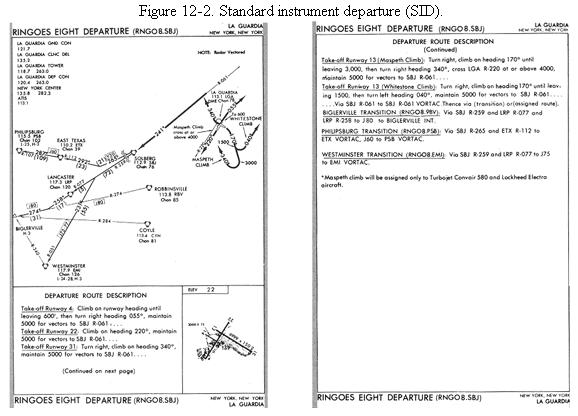
ATC issues you the following "abbreviated clearance" which includes a
Standard Instrument Departure (SID) (Fig. 12-2):
FASTFLIGHT FIVE FOUR
THREE TWO KILO - CLEARED TO LA GUARDIA
AS FILED - RINGOES EIGHT
DEPARTURE PHILLIPSBURG TRANSITION
- MAINTAIN EIGHT THOUSAND -
DEPARTURE CONTROL FREQUENCY WILL
BE ONE TWO ZERO POINT FOUR - SQUAWK
ZERO SEVEN ZERO ZERO.
This clearance may be readily copied in shorthand as follows:
CAF/RNGO8/PSB/M80/DPC 120.4/SQ 0700.
The information
contained in this clearance for a Standard Instrument Departure is an
abbreviation of Air Traffic instructions too complicated and extensive for you
to follow and copy, regardless of your proficiency in using clearance shorthand.
Study of the route specified in the clearance shows the importance of the
Standard Instrument Departure. At common operating speeds in modern light
aircraft, the clearance allows no time for extensive reference to your departure
chart. You will be too busy flying your aircraft, navigating, and communicating
with ATC to familiarize yourself with the clearance data after you have accepted
it. You must known the locations of the specified navigation facilities,
together with the route and point-to-point time, BEFORE accepting the clearance.
 |
The Standard Instrument Departure, which you have available during
preflight planning, enables you to study and understand the details of your
departure before filing your IFR flight plan. It permits you to set up your
communications and navigation equipment and to be ready for departure before
requesting IFR clearance from the tower. The SID eliminates unnecessarily long
delays in clearance delivery that would result in inconvenience and expense to
airspace users as well a revisions in flight planning for pilots awaiting
departure.
Regardless of the nature of your clearance, it is imperative that you
are prepared to understand it, and having accepted it, comply with ATC
instructions to the letter. It is your privilege to request a clearance
different from that issued by ATC if you consider another course of action more
practicable or if your aircraft equipment limitations or other considerations
make acceptance of the clearance inadvisable. Though FAR Part 91 does not
require you to accept a clearance, it is very specific as to your privileges and
responsibilities.
1. Responsibility and authority of the pilot in command.
(a) The pilot in command of an aircraft is directly responsible
for, and is the final authority as to, the operation of that aircraft.
(b) In an emergency requiring immediate action, the pilot in
command may deviate from a rule to the extent required to meet that emergency.
(c) Each pilot in command who deviates from a rule shall, upon
the request of the Administrator, send a written report of that deviation to the
Administrator.
2. Compliance with ATC clearances and instructions.
(a) When an ATC clearance has been obtained, no pilot in
command may deviate from that clearance, except in an emergency, unless he
obtains an amended clearance. However, except in positive controlled airspace,
this paragraph does not prohibit him from canceling an IFR flight plan if he is
operating in VFR weather conditions. If a pilot is uncertain of the meaning of
an ATC clearance, he shall immediately request clarification from ATC.
(b) Except in an emergency, no person may, in an area in which
air traffic control is exercised, operate an aircraft contrary to an ATC
instruction.
(c) Each pilot in command who deviates, in an
emergency, from an ATC clearance or instruction shall notify ATC of that
deviation as soon as possible.
(d) Each pilot in command who
(though not deviating from a rule of this subpart) is given priority by ATC in
an emergency, shall, if requested by ATC, submit a detailed report of that
emergency within 48 hours to the chief of that ATC facility.
An ATC clearance presupposes that you are equipped and will comply with
the applicable Regulations (Part 91), as follows:
1. Instruments and Equipment IFR Flight. The following instruments and
equipment are required:...Two-way radio communications system and navigational
equipment appropriate to the ground facilities to be used....
2. IFR
Radio Communications. The pilot in command of each aircraft operated under IFR
controlled airspace shall have a continuous watch maintained on the appropriate
frequency....
3. Course to be Flown. Unless otherwise authorized by
ATC, no person may operate an aircraft within controlled airspace, under IFR,
except as follows:
(a) On a Federal Airway, along the
centerline of that airway.
(b) On any other route, along the
direct course between the navigational aids or fixes defining that route.
However, this section does not prohibit maneuvering the aircraft to
pass well clear of other air traffic or the maneuvering of the aircraft, in VFR
conditions, to clear the intended flight path both before and during climb or
descent.
 |
FAATest.com
- Aviation Library
Dauntless
Software hosts and maintains this library as a service to pilots
and aspiring pilots worldwide. Click
here for ways to show your appreciation for this service.
While much of this material comes from the FAA, parts of it are (c) Dauntless Software, all rights reserved. Webmasters: please
do not link directly to individual books in this library--rather,
please link to our main web page at www.dauntless-soft.com or
www.faatest.com. Thanks! |
|