Visual Inspection of the Airplane
To a pilot, the airworthiness of the airplane is both a
legal obligation and a direct responsibility. Careful personal attention
to preflight procedures is the mark of a safe pilot and will be repaid not
only in safety, but in lower airplane maintenance costs.
As the pilot approaches the airplane, the external visual inspection
should be started by looking for hazardous obstructions in the parking
area, and for dripping oil and fuel leaks under the airplane. Upon
reaching the airplane all tiedowns, control locks, and chocks should be
removed and the general appearance of the airplane checked for signs of
damage such as dents, cracks, or scratches. Then, the preflight inspection
should be performed in accordance with the printed checklist provided by
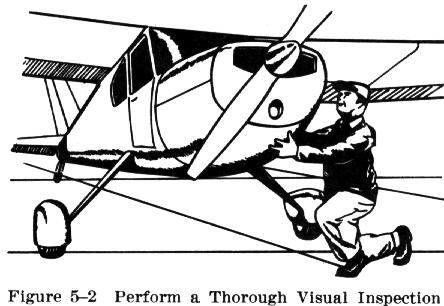
the airplane manufacturer (Fig. 5-2). |
 |
Water and dirt contamination in the airplane's fuel system is
potentially dangerous; therefore, the pilot should take certain actions to
prevent contamination or eliminate contamination that may have occurred. If the
airplane's weight and balance will not be adversely affected for the next flight
the fuel tanks should be completely filled after each flight, or at least after
the last flight of the day. The reason is that when air in the fuel tanks cools,
the moisture it contains condenses into water, and contaminates the fuel. The
more fuel there is in the tanks, the less moist air the tanks will contain and
the less condensation and contamination will occur.
The pilot should always assume that the fuel in the airplane may
be contaminated with water, and take the necessary steps to eliminate it during
the preflight inspection. A substantial amount of fuel should be drained from
the fuel strainer (gascolator) quick drain and, if possible, from each fuel tank
sump into a transparent container to check for dirt and water. Water will be
noticeable since it will sink to the bottom of the sample. Water (being heavier
than gasoline), seeks the lowest levels in the fuel system - that is where the
fuel drains are located. If water is found in the first sample, drain further
samples until no trace appears.
A second preventive measure is to avoid refueling from cans and
drums, which may introduce fuel contamination by dirt or other impurities.
Since each make and model of airplane has different features to
inspect, it is impractical to provide an appropriate checklist here.
Nonetheless, the following are some of the major items that should be given
particular attention during a preflight inspection:
1. Check landing gear control DOWN (if
retractable gear).
2. Turn master switch ON;
check the fuel quantity gauges.
3. Check
master switch and ignition switch OFF.
4.
Visually check fuel supply in tanks; secure the tank caps.
5. Drain fuel system sump (gascolator); check
for contamination.
7. Check that fuel system
vents are open.
8. Check oil level (ensure
that dipstick is properly seated).
9. Check
for obvious fuel or oil leaks.
10. Check
cowling and inspection covers for security.
11. Check propeller and spinner for defects or nicks.
12. Check tires for cuts, wear, and proper
inflation.
13. Check nose gear and landing
gear shock struts for proper inflation. Check wheel wells (if retractable gear).
14. Check hydraulic lines and landing gear
struts for leaks.
15. Inspect tailwheel
spring, steering arms, steering chains, and tire inflation (if tailwheel type).
16. Remove pitot tube cover, if installed,
and inspect pitot tube for clear opening.
17.
Inspect static air source for clean opening.
18. Ensure that wings and control surfaces are free of mud, snow, ice, or frost.
19. Remove control surface lock, if
installed.
20. Check for damage and
operational interference of control surfaces or hinges.
21. Check landing flaps for signs of
operational interference.
22. Check
windshield and cabin windows for cleanliness.
23. Check carburetor air intake for obstructions.
24. Check baggage for proper storage and
security.
25. Close and secure the baggage
compartment door.
 |
FAATest.com
- Aviation Library
Dauntless
Software hosts and maintains this library as a service to pilots
and aspiring pilots worldwide. Click
here for ways to show your appreciation for this service.
While much of this material comes from the FAA, parts of it are (c) Dauntless Software, all rights reserved. Webmasters: please
do not link directly to individual books in this library--rather,
please link to our main web page at www.dauntless-soft.com or
www.faatest.com. Thanks! |
|