| Ground Operations
At many airports there usually is considerable
activity in and around the parking area - aircraft may be operating at high
power settings, taxiing in and out of the area, taking off and landing on nearby
runways, and fuel trucks and people may be moving among the aircraft.
Consequently, constant vigilance must be exercised at all times while performing
ground operations.
The propeller is the most dangerous part of
the airplane, since under certain light conditions, it is difficult to see a
revolving propeller. This may give the illusion that it is not there. As a
result, the files of FAA Aviation Safety Offices contain many cases that read:
"Victim walked into a rotating propeller."
All pilots should form the habit of walking along the inner edge
of the terminal ramp or parking area to the point at which the assigned airplane
is located. When the parking spot is reached, the airplane should be approached
from the rear. (This same procedure should be followed, in reverse order,
whenever leaving the airplane.) While approaching the airplane, the pilot should
note the presence of obstructions and articles such as fire extinguishers,
fueling or maintenance equipment, or chocks that could be a hazard when taxiing
the airplane.
| The accomplishment of a safe, pleasant flight begins with a careful
visual inspection before the pilot enters the airplane. In addition, a
planned routine of starting, warmup, taxiing, and before takeoff checks
will assure that the airplane is operating properly while there still is
an opportunity to correct any discrepancy which may appear. When well
organized, these checks can be made quickly, and soon will become matters
of habit; the appearance, sound, and even the odor in the airplane will
become familiar, and anything unfamiliar will alert the pilot that
something is not as it has been or should be.
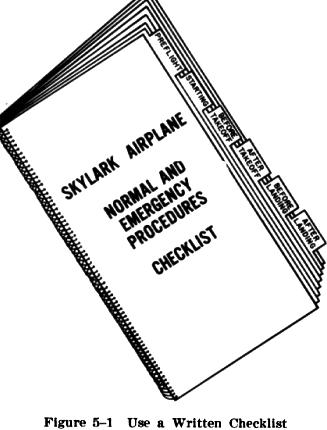
The use of an appropriate written checklist to inspect and start the
airplane, as well as for all other ground checks and procedures, is highly
recommended.
Checklists are guides for use in ensuring that all
necessary items are checked in a logical sequence. The beginning pilot
should not get the idea that the list is merely a crutch for poor memory -
even the most experienced professional pilots never attempt to fly without
an appropriate checklist. The habit of using a written checklist for the
airplane being used should be so instilled in pilots that they will follow
this practice throughout their flying activities (Fig. 5-1). |
|
 |
FAATest.com
- Aviation Library
Dauntless
Software hosts and maintains this library as a service to pilots
and aspiring pilots worldwide. Click
here for ways to show your appreciation for this service.
While much of this material comes from the FAA, parts of it are (c) Dauntless Software, all rights reserved. Webmasters: please
do not link directly to individual books in this library--rather,
please link to our main web page at www.dauntless-soft.com or
www.faatest.com. Thanks! |
|