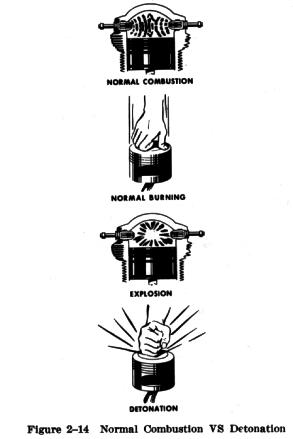
| Normal combustion occurs when the fuel/air mixture ignites in the
cylinder and burns progressively with a normal pressure increase,
producing maximum pressure immediately after the piston passes top dead
center of the compression stroke (Fig. 2-14).
A flame front starts at the spark plugs and travels across the
combustion chamber at a speed of approximately 70 to 100 feet per second.
The velocity of the flame front is influenced by the type of fuel, the
ratio of fuel to air mixture, the pressure on the fuel/air mixture, and
the temperature of the fuel/air mixture. The pilot has control of these
items by ensuring that (1) the airplane has been serviced with the
recommended grade of fuel; (2) the pressure of the fuel/air mixture is
properly regulated by propeller and throttle controls; (3) the engine
temperature is adequately regulated by use of the cowl flaps and by the
engine speed when an internal supercharger is used; and (4) the fuel/air
ratio is accurately adjusted by the mixture control. When any of these
factors is not properly controlled, abnormal combustion will result.
When the fuel/air mixture is ignited by means other than the normal
spark ignition, the result is abnormal combustion. This abnormal
combustion is divided into two distinct types - detonation and
preignition. |
|