| Landing Gear
The main landing gear forms the principal support of the airplane on land or
water. It may include wheels, floats, skis, shock absorbing equipment, brakes,
retracting mechanism with controls and warning devices, and structural members
necessary to attach the gear to the primary airplane structure. The airplane
also has either a tailwheel or a nosewheel, or may have a tail skid. The
tailwheel or nosewheel also supports the airplane on the ground but steering and
directional control are their primary functions.
Modern airplanes having the nosewheel installation are called tricycle gear
airplanes. A nosewheel gear arrangement has at least three advantages:
1. It allows more forceful application of the
brakes during landings at high speeds without resulting in the airplane nosing
over.
2. It permits better forward visibility
for the pilot during takeoff, landing, and taxiing.
3. It tends to prevent ground looping
(swerving) by providing more directional stability during ground operation,
since the airplane's center of gravity (CG) is forward of the main wheels. The
forward CG, therefore, tends to keep the airplane moving forward in a straight
line rather than ground looping.
The main landing gear assembly consists of two main wheels and struts. Each
main strut is attached to the primary structure of the fuselage or the wing.
With the tailwheel type of airplane, the two main struts are attached to the
airplane slightly ahead of the airplane's center of gravity. In the nosewheel
type, the two main struts are attached to the airplane slightly to the rear of
the airplane's center of gravity.
| The landing gear shock struts may be either self-contained
hydraulic units or flexible spring like structures that support the
airplane on the ground and protect the airplane's structure by absorbing
and dissipating the shock loads of landing and taxiing over rough
surfaces, much as they do on automobiles. Many airplanes are equipped with
what is known as oleo or oleo/pneumatic struts, the basic parts of which
are a piston and a cylinder. The lower part of the cylinder is filled with
hydraulic fluid and the piston operates in this fluid; the upper part is
filled with air. Several holes in the piston permit fluid to pass from one
side of the piston to the other as the strut compresses and expands and
forces the piston back and forth.
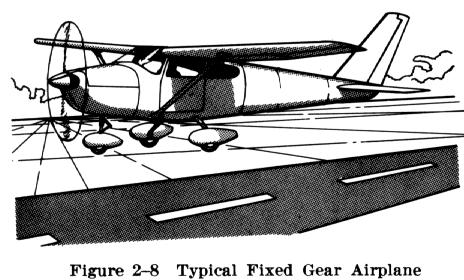
The landing gear of many light airplanes is fixed in the extended
position (Fig. 2-8), while in the so called complex airplanes it is
retractable in flight. |
 |
 |
FAATest.com
- Aviation Library
Dauntless
Software hosts and maintains this library as a service to pilots
and aspiring pilots worldwide. Click
here for ways to show your appreciation for this service.
While much of this material comes from the FAA, parts of it are (c) Dauntless Software, all rights reserved. Webmasters: please
do not link directly to individual books in this library--rather,
please link to our main web page at www.dauntless-soft.com or
www.faatest.com. Thanks! |
|