| Aircraft Engines
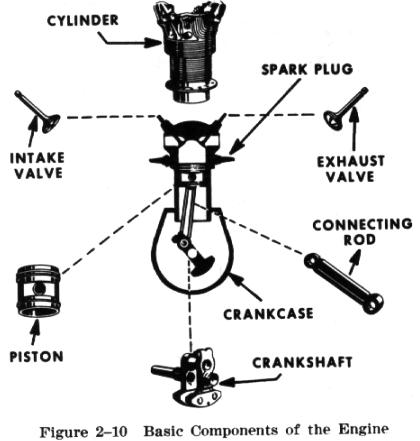
Since the engine develops the power to give the airplane its forward motion, thus enabling it to fly, the pilot should have a basic knowledge of how an engine works, and how to control its power. The engine is commonly referred to as the "powerplant." Not only does it provide power to propel the airplane, but it powers the units which furnish electrical, hydraulic, and pneumatic energy for operation of electric motors, pumps, controls, lights, radio, instruments, retractable landing gear, and flaps. In many cases the engine also provides heat for crewmembers' and passengers' comfort and for deicing equipment. In view of these varied functions it is properly referred to as an "engine" or "powerplant" rather than as a "motor." The study of the powerplant begins with the definition of the term "internal combustion engine." Internal combustion is the process by which a mixture of fuel and oxygen is burned in a chamber from which the power can be taken directly. This type of combustion can be contrasted to external combustion, such as occurs in a steam engine, in which water is heated in one chamber and transferred as steam to another chamber for transmission of its power. The word "engine" therefore, is interpreted as meaning a machine in which heat energy (released from burning gases) is transformed into mechanical energy. Two types of aircraft engines are in common use today. One type, used so widely in the typical training airplanes, is known as the reciprocating engine. In this type, pressures from burning and expanding gases cause a piston to move up and down in an enclosed cylinder. This reciprocating motion of the piston is transferred through a connecting rod into rotary motion by a crankshaft, splined or geared to a propeller. In the second type, the turbine jet engine generally used in military, airline, and many corporate type airplanes, the continuous burning, expansion, and exhausting of gases in one direction pushes the engine, and therefore the airplane, in the opposite direction. Because the latter type engine is found only in airplanes with very high performance characteristics, it will not be dealt with in this handbook. Reciprocating engines can be further classified as to the manner in which the
fuel is introduced into the cylinder. In training type airplanes the usual
method is by carburetion, a process of atomizing, vaporizing, and mixing
gasoline with air in a unit called a carburetor, before the mixture enters the
engine's cylinders. The mixture of gasoline and air is then drawn into each of
the cylinders by the up and down moving pistons, or is forced under pressure
into the cylinders by a blower or supercharger. The other method of supplying
the combustible fuel is by fuel injection, whereby the gasoline is injected
under pressure by a pump directly into the cylinders where it vaporizes and
mixes with air. The fuel/air mixture is then fired (ignited) by timed electric
ignition.
|