| Landings
In comparison, the land surfaces of all airports are of firm, static matter, whereas the surface of water is changing continually as a fluid. Floating obstacles and various activities frequently present on the water surface may present serious hazards during seaplane landings, especially to the careless pilot. For these reasons, it is advisable to circle the area of intended landing and examine it thoroughly for obstructions such as buoys or floating debris, and to note the direction of movement of any boats which may be operating at the intended landing site. Most established seaplane bases are equipped with a wind sock to
indicate wind direction, but if one is not available the wind can still be
determined prior to landing. The following are but a few of the methods by which
to determine the wind direction. In seaplanes equipped with retractable landing gear (amphibians), it is extremely important to make certain that the wheels are in the retracted position when landing on water. Wherever possible, a visual check of the wheels themselves is recommended, in addition to checking the landing gear position indicating devices. A wheels down landing on water is almost certain to capsize the seaplane, and is far more serious than landing the seaplane wheels up on land. The water rudder should also be in the retracted position during landings. The landing approach procedure in a seaplane is very similar to that of a landplane and is governed to a large extent by pilot preference, wind, and water conditions. Under normal conditions a seaplane can be landed either power
off or power on; however, power on landings are recommended in most cases,
because this technique gives the pilot more positive control of the seaplane and
provides a means for correcting errors in judgment during the approach and
landing. So that the slowest possible airspeed can be maintained, the power on
landing should be accomplished with maximum flaps extended. The seaplane should
be trimmed to the manufacturer's recommended approach speed, and the approach
made similar to that of a landplane.
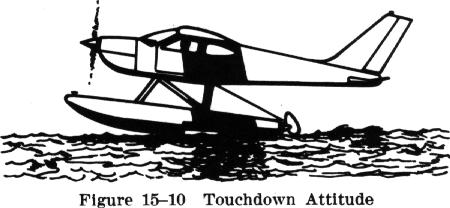
After contacting the water, gradually increase back elevator pressure. It may be desirable at times to remain on the step after touchdown. To do so, merely add sufficient power and maintain the planing attitude immediately after touchdown. Flat, calm, glassy water is perhaps the most deceptive condition that a seaplane pilot will experience. The calmness of the water has a psychological effect in that it tends to overly relax the pilot when there should be special alertness. Consequently, this surface condition is frequently the most dangerous for seaplane operation. From above, the mirror like appearance of smooth water looks most inviting and easy to land on but as many pilots have suddenly learned, adequate depth perception may be lacking. Even experienced pilots misjudge height above the water, making timely roundouts difficult. This results in either flying bow first into the water or stalling the seaplane at too great a height above the water. When the water is crystal clear and glassy, pilots often attempt to judge height by using the bottom of the lake as a reference, rather than the water surface. An accurately set altimeter may be used as an aid in determining height above the glassy water. However, a more effective means is to make the approach and landing near the shoreline so it can be used as a reference for judging height above the water. Another method is to cross the shoreline on final approach at the lowest possible safe altitude so that a height reference is maintained to within a few feet of the water surface. Glassy water landings should always be made power on, and the need for this type of landing should be recognized in ample time to set up the proper final approach. During the final approach the seaplane should be flown at the best nose high attitude, using flaps as required or as recommended by the manufacturer. A power setting and pitch attitude should be established that will result in a rate of descent not to exceed 150 feet per minute and at an airspeed approximately 10 knots above stall speed. With a constant power setting and a constant pitch attitude, the airspeed will stabilize, and remain so if no changes are made. The power or pitch should be changed only if the airspeed or rate of descent deviates from that which is desired. Throughout the approach the seaplane performance should be closely monitored by cross checking the instruments until contact is made with the water. Upon touchdown, back elevator control pressure should be applied as necessary to maintain the same pitch attitude. Throttle should be reduced or closed only after the pilot is sure that the aircraft is firmly on the water. Several indications should be used. 1. A slight deceleration force will be felt.
All three cues should be used because accidents have resulted from curbing the power rapidly after initially touching the water. To the pilot's surprise a skip had taken place and it was found when the power was cut, the aircraft was 10 to 15 feet in the air and not on the water, resulting in a stall and substantial damage. Maintaining a nose up, wings level attitude, at the correct speed and a small rate of descent, are imperative for a successful glassy water landing. All aspects of this approach and landing should be considered prior to its execution. Bear in mind that this type of approach and landing will usually consume considerable landing distance. Landing near unfamiliar shorelines increases the possibility of encountering submerged objects and debris. It is impractical to describe an ideal rough water procedure because of the varying conditions of the surface. In most instances, though, the approach is made the same as for any other water landing. It may be better however, to level off just above the water surface and increase the power sufficiently to maintain a rather flat attitude until conditions appear to be more acceptable, and then reduce the power to touchdown. If severe bounces occur, power should be increased and a search made for a more ideal landing spot. Generally, it is recommended that night water landings in seaplanes be avoided, since they can be extremely dangerous due to the difficulty or almost impossibility of seeing objects in the water. If it becomes necessary to land at night in a seaplane, serious consideration should be given to landing at a lighted airport. An emergency landing can be made on land in seaplanes with little or no damage to the floats or hull. Touchdown should be made with the keel of the floats or hull as nearly parallel to the surface as possible. After touchdown, full back elevator must be applied and additional power applied to lessen the rapid deceleration and nose over tendency. Don't worry about getting stopped with additional power after touchdown. It will stop! The power is applied only for increasing elevator effectiveness.
|