| Power Off Accuracy Approaches
These are approaches and landings made by gliding with the
engine idling, through a specific pattern to a touchdown beyond and within 200
feet of a designated line or mark on the runway. The objective is to instill in
the pilot the judgment, technique, and procedures necessary for accurately
flying the airplane, with no power, to a safe landing.
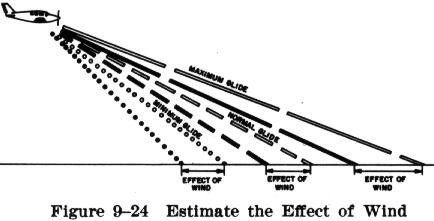
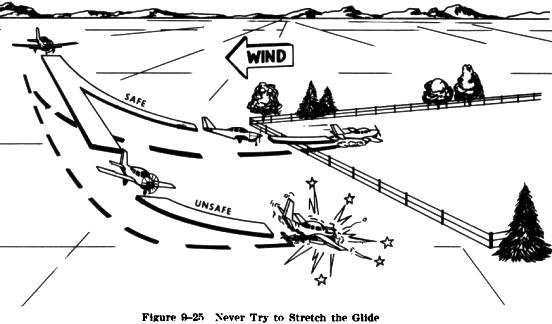
Therefore, the best aid in perfecting the ability to judge height above this altitude is through the indications of the altimeter and associating them with the general appearance of the earth. The judgment of altitude in feet, hundreds of feet, or thousands of feet is not nearly so important though, as the ability to estimate gliding angle and its resultant distance. The pilot who knows the normal glide angle of the airplane can estimate with reasonable accuracy, the approximate spot along a given ground path at which the airplane will land, regardless of altitude. But, the pilot who also has the ability to accurately estimate altitude, can judge just how much maneuvering is possible during the glide, which is important to the choice of landing areas in an actual emergency. The objective of a good final approach is to descend at an angle that will permit the airplane to reach the desired landing area, and at an airspeed that will result in a minimum of floating just before touchdown. To accomplish this it is essential that both the descent angle and the airspeed be accurately controlled. Unlike a "normal approach" when the power setting is variable, on a "power off approach" the power is fixed at the idle setting. Therefore, pitch attitude rather than power must be adjusted to control the airspeed. This, of course, also changes the glide or descent angle. By lowering the nose to keep the approach airspeed constant, the descent angle will steepen. If the approach is too high, lower the nose; when the approach is too low, raise the nose. However, if the pitch attitude is raised too high, the airplane will settle very rapidly due to a slow airspeed and insufficient lift. For this reason, NEVER TRY TO STRETCH A GLIDE to reach the desired landing spot (Fig. 9-25).
Uniform approach patterns such as the 90 degree, 180 degree, or 360 degree power off approaches, are described on the following pages. Practice in these approaches provides the pilot with a basis on which to develop judgment in gliding distance and in planning an approach. The basic procedure in these approaches involves closing the throttle at a given altitude, and gliding to a "key position." This position, like the pattern itself, must not be allowed to become the primary objective, as it is merely a convenient point in the air from which the pilot can best judge whether the glide will safely terminate at the desired spot. The selected "key position" should, of course, be one that is appropriate for the available altitude and the wind condition. From the key position, the pilot must constantly evaluate the situation. It must be emphasized that, although accurate spot touchdowns
are important, safe and properly executed approaches and landings are vital. The
pilot must never sacrifice a good approach or landing just to land on the
desired spot.
|