| Particularly during the after landing roll, special attention
must be given to maintaining directional control by use of rudder, or
nosewheel/tailwheel steering, while keeping the upwind wing from rising by
use of aileron.
When an airplane is airborne it moves with the air mass in
which it is flying regardless of the airplane's heading and speed.
However, when an airplane is on the ground it is unable to move with the
air mass (crosswind) because of the resistance created by ground friction
on the wheels.
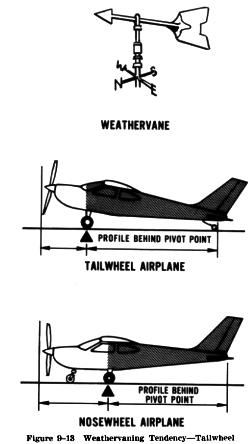
Characteristically, an airplane has a greater profile or side area,
behind the main landing gear than forward of it (Fig. 9-13). With the main
wheels acting as a pivot point and the greater surface area exposed to the
crosswind behind that pivot point, the airplane will tend to turn or
"weathervane" into the wind.
Though it is characteristic of most airplanes, this
weathervaning tendency is more prevalent in the tailwheel type because the
airplane's surface area behind the main landing gear is greater than in
nosewheel type airplanes.
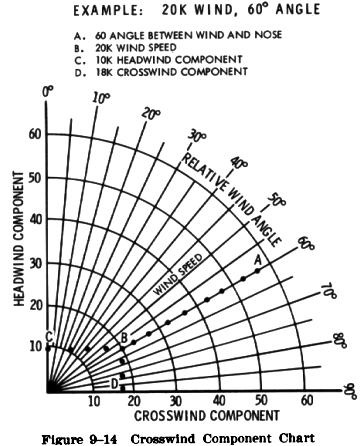
Wind acting on an airplane during crosswind landings is the result of
two factors - one is the natural wind which acts in the direction the air
mass is traveling, while the other is induced by the movement of the
airplane and acts parallel to the direction of movement. Consequently, a
crosswind has a headwind component acting along the airplane's ground
track and a |