| Theories of Flight
A balloon rises in the air because it is filled with a gas which
is lighter than the air around it. But an airplane, being heavier than the air
surrounding it, cannot float as does a balloon; consequently, it must get its
lift in a different manner. In effect, it must do something to the air
surrounding it to make the air support its greater weight. To act on the air,
the airplane must be placed in motion.
The majority of general aviation type airplanes employ a
reciprocating engine to turn a propeller that "bites" into the air forcing the
air backward while pulling the airplane forward. This leads our discussion to
several basic laws of physics that help in explaining how an airplane flies.
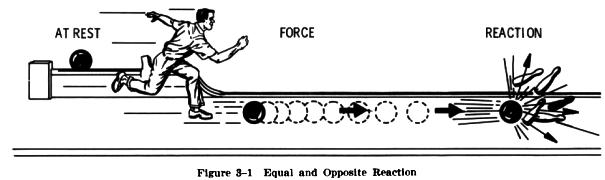
The English philosopher and mathematician Sir Isaac Newton is
credited with having observed in 1687 that "for every action there is an equal
and opposite reaction" (Fig. 3-1). This principle applies whenever two things
act upon each other, such as the air and the propeller, or the air and the wing
of an airplane. In short, the statement about "action and reaction" tells us how
lift and propulsion of airplanes are produced.
The only way air can exert a force on a solid body, such as an
airplane's wing, is through pressure. In the 1700's, Daniel Bernoulli (a Swiss
mathematician) discovered that if the velocity of a fluid (air) is increased at
a particular point, the pressure of the fluid (air) at that point is decreased.
The airplane's wing is designed to increase the velocity of the air flowing over
the top of the wing as it moves through the air. To do this, the top of the wing
is curved, while the bottom is relatively flat. The air flowing over the top
travels a little farther (since it is curving) than the air flowing along the
flat bottom. This means the air on top must go faster. Hence, the pressure
decreases, resulting in a lower pressure (as Bernoulli stated) on top of the
wing and a higher pressure below. The higher pressure then pushes (lifts) the
wing up toward the lower pressure area (Fig. 3-2).
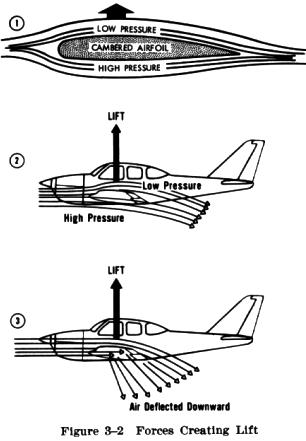 |
At the same time, the air flowing along the underside of the wing is
deflected downward. As stated in Newton's theorem, "for every action there
is an equal and opposite reaction." Thus, the downward deflection of air
reacts by pushing (lifting) the wing upward (Fig. 3-2). This is like the
planing effect of a speedboat or water skier skimming over the water. To
increase the lift, the wing is tilted upward in relation to the oncoming
air (relative wind) to increase the deflection of air. Relative wind
during flight is not the natural wind, but is the direction of the airflow
in relation to the wing as it moves through the air. The angle at which
the wing meets the relative wind is called the angle of attack.
These two natural forces, pressure and deflection, produce
lift. The faster the wing moves through the air and the greater the two
forces become, the more lift is developed. Another of Newton's theorems
can be used to explain just how much air deflection is needed to lift an
airplane. This law of motion says "the force produced will be equal to the
mass of air deflected multiplied by the acceleration given to it." From
this we can see the way lift, speed, and angle of attack are related.
The amount of lift needed can be produced by moving a large mass of air
through the process of making a small change in velocity, or by moving a
small mass of air through the process of making a large change in
velocity. For example, at a high speed where the wing affects a large
amount of air, only a | small angle of attack
is needed to deflect the air a small amount. Conversely, at low speeds during
which the wing affects a lesser amount of air, a larger angle of attack is
needed to deflect the air a large amount. Thus, the angle of attack at various
speeds must be such that the deflection of air is adequate for the amount of
lift needed.
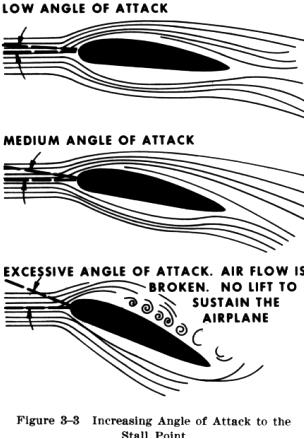
| If the airplane's speed is too slow, the angle of attack required will
be so large that the air can no longer follow the upper curvature of the
wing. This results in a swirling, turbulent flow of air over the wing and
"spoils" the lift. Consequently, the wing stalls. On most airplanes this
critical angle of attack is about 15 to 20 degrees (Fig. 3-3). Stalls will
be thoroughly explained in the chapter on Proficiency Flight Maneuvers.
As noted earlier, when the propeller rotates, it "bites"
into the air, thereby providing the force to pull (or push) the airplane
forward. This forward motion causes the airplane to act on the air to
produce lift. The propeller blades, just like a wing, are curved on one
side and straight on the other side. Hence, as the propeller is rotated by
the engine, forces similar to those of the wing create "lift" in a forward
direction. This is called thrust.
Up to this point the discussion has related only to the "lifting"
force. Before an understanding of how an airplane flies is complete, other
forces must be discussed.
|
|
 |
FAATest.com
- Aviation Library
Dauntless
Software hosts and maintains this library as a service to pilots
and aspiring pilots worldwide. Click
here for ways to show your appreciation for this service.
While much of this material comes from the FAA, parts of it are (c) Dauntless Software, all rights reserved. Webmasters: please
do not link directly to individual books in this library--rather,
please link to our main web page at www.dauntless-soft.com or
www.faatest.com. Thanks! |
|