Forces in Climbs
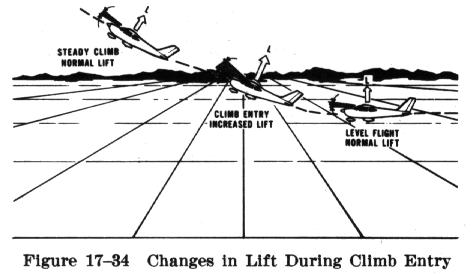
| For all practical purposes, the wing's lift in a steady
state normal climb is the same as it is in a steady level flight at the
same airspeed. Though the airplane's flightpath has changed when the climb
has been established, the angle of attack of the wing with respect to the
inclined flightpath reverts to practically the same values, as does the
lift. There is an initial momentary change, however, as shown in Figure
17-34. During the transition from straight and level flight to a climb, a
change in lift occurs when back elevator pressure is first applied.
Raising the airplane's nose increases the angle of attack and momentarily
increases the lift. Lift at this moment is now greater than weight and
starts the airplane climbing. After the flightpath is stabilized on the
upward incline, the angle of attack and lift again revert to about the
level flight values. |
|
.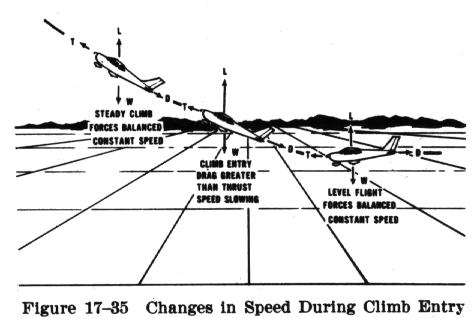 |
If the climb is entered with no change in power setting, the
airspeed gradually diminishes because the thrust required to maintain a
given airspeed in level flight is insufficient to maintain the same
airspeed in a climb. When the flightpath is inclined upward, a component
of the airplane's weight acts in the same direction as, and parallel to,
the total drag of the airplane, thereby increasing the total effective
drag. Consequently, the total drag is greater than the power, and the
airspeed decreases. The reduction in airspeed gradually results in a
corresponding decrease in drag until the total drag (including the
component of weight acting in the same direction) equal the thrust (Fig.
17-35). Due to momentum, the change in airspeed is gradual, varying
considerably with differences in airplane size, weight, total drag, and
other factors. |
Generally speaking, the forces of thrust and drag, and lift and
weight, again become balanced when the airspeed stabilizes but at a value lower
than in straight and level flight at the same power setting. Since in a climb
the airplane's weight is not only acting downward but rearward along with drag
additional power is required to maintain the same airspeed as in level flight.
The amount of power depends on the angle of climb. When the climb is established
so steep that there is insufficient power available, a slower speed results. It
will be seen then that the amount of reserve power determines the climb
performance of the airplane. This is discussed further in the section on Climb
Performance.
 |
FAATest.com
- Aviation Library
Dauntless
Software hosts and maintains this library as a service to pilots
and aspiring pilots worldwide. Click
here for ways to show your appreciation for this service.
While much of this material comes from the FAA, parts of it are (c) Dauntless Software, all rights reserved. Webmasters: please
do not link directly to individual books in this library--rather,
please link to our main web page at www.dauntless-soft.com or
www.faatest.com. Thanks! |
|