Elevator Trim Stall
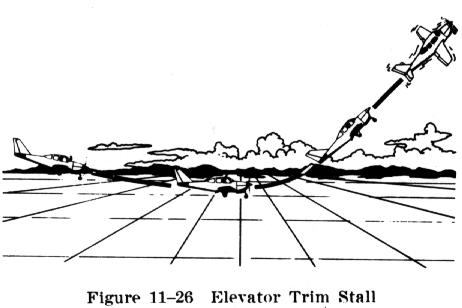 |
This demonstration maneuver shows what can happen when full power is
applied for a go-around and positive control of the airplane is not
maintained. Such a situation may occur during a go-around procedure from a
normal landing approach or a simulated forced landing approach, or
immediately after a takeoff (Fig. 11-26). The objective of the
demonstration is to show the importance of making smooth power
applications, overcoming strong trim forces and maintaining positive
control of the airplane to hold safe flight attitudes, and using proper
and timely trim techniques.
At a safe altitude after ensuring that the area is clear of other air
traffic, the pilot should slowly retard the throttle, and extend the
landing gear (if retractable gear). | One-half
to full flaps should be lowered, the throttle closed, and altitude maintained
until the airspeed approaches the normal glide speed. When the normal glide is
established, the airplane should be trimmed for the glide just as would be done
during a landing approach (nose up trim).
During this simulated final approach glide, the throttle is then
advanced smoothly to maximum allowable power as would be done in a go-around
procedure. The combined forces of thrust, torque, and back elevator trim will
tend to make the nose rise sharply and turn to the left. To demonstrate what
could occur if positive control of the airplane were not maintained, no
immediate attempt should be made to correct these forces.
When the throttle is fully advanced and the pitch attitude
increases above the normal climbing attitude, and it is apparent that a stall is
imminent, forward pressure must be applied to return the airplane to the normal
climbing attitude. While holding the airplane in this attitude, the trim should
then be adjusted to relieve the heavy control pressures and the normal go-around
and leveloff procedures completed.
The pilot should recognize when the stall is imminent and must
take prompt action to prevent a completely stalled condition. It is imperative
that a full stall not occur during an actual go-around from a landing approach,
since the amount of pitch change necessary for recovery may be such that the
airplane would dive into the ground.
 |
FAATest.com
- Aviation Library
Dauntless
Software hosts and maintains this library as a service to pilots
and aspiring pilots worldwide. Click
here for ways to show your appreciation for this service.
While much of this material comes from the FAA, parts of it are (c) Dauntless Software, all rights reserved. Webmasters: please
do not link directly to individual books in this library--rather,
please link to our main web page at www.dauntless-soft.com or
www.faatest.com. Thanks! |
|